

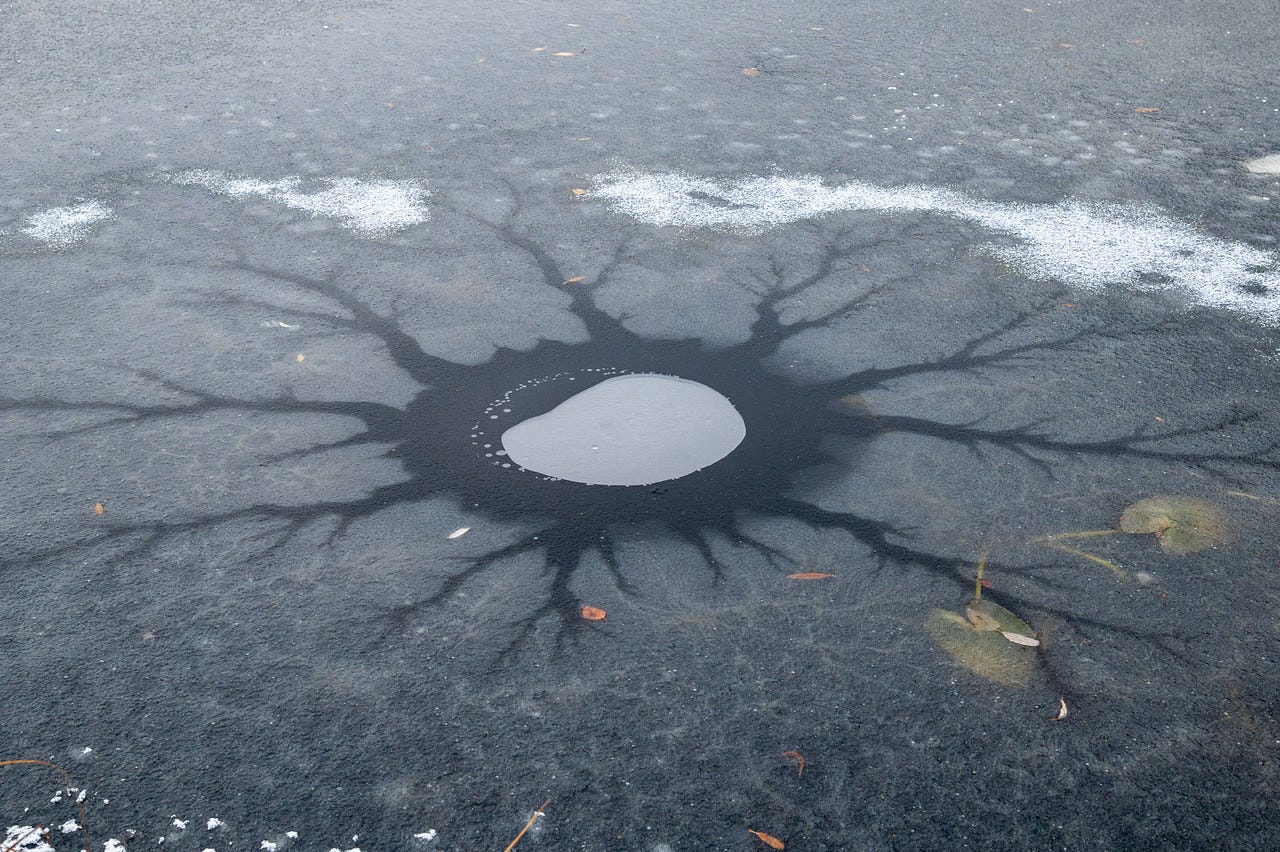
Recently, I was walking near my home by Ballaine Lake when I saw some intriguing formations on the ice. I’d seen them before, but I didn’t really know what they were or how they form, so the first thing I did when I got home was Google “dendritic pattern on lake ice.” Turns out, they are called lake stars, and they are way more interesting than I initially thought.
Thoreau described them in Walden (1854), recalling the winter of 1846, in the chapter “The Pond in Winter":
When I began to cut holes for sounding, there were three or four inches of water on the ice under a deep snow which had sunk it thus far; but the water began immediately to run into these holes, and continued to run for two days in deep streams, which wore away the ice on every side, and contributed essentially, if not mainly, to dry the surface of the pond; for, as the water ran in, it raised and floated the ice. This was somewhat like cutting a hole in the bottom of a ship to let the water out. When such holes freeze, and a rain succeeds, and finally a new freezing forms a fresh smooth ice over all, it is beautifully mottled internally by dark figures, shaped somewhat like a spider’s web, what you may call ice rosettes, produced by the channels worn by the water flowing from all sides to a centre.
What he describes, water flowing into the hole, is somewhat backward compared with how their formation is observed and described today. But the result is similar.
Lake stars have many names: ice octopi, ice rosettes, spring holes, Dampflöcher (steam holes). They’re a common occurrence on frozen lakes and ponds, especially early in the freeze season. They often form when the lake begins to freeze during snowfall.
Under these conditions, a thin layer of snow falls on the recently frozen or slushy lake surface. Small holes in the ice let relatively warm lake water slowly seep through. As this water flows through the porous snow or slush layer above, it often forms a wet pool. As the water spreads, wherever it spreads faster (because of variations in flow, grain size, or capillary action), it melts the slush faster, opening a path for even more flow. This causes the arms to form, while heat diffusing sideways prevents too many arms from forming.
The slushy ice refreezes later, leaving the darkened arms in the otherwise bubbly ice. The refrozen, water-soaked channels don’t have as much trapped air, so the dark lake beneath is visible through them.
Methane Bubbles
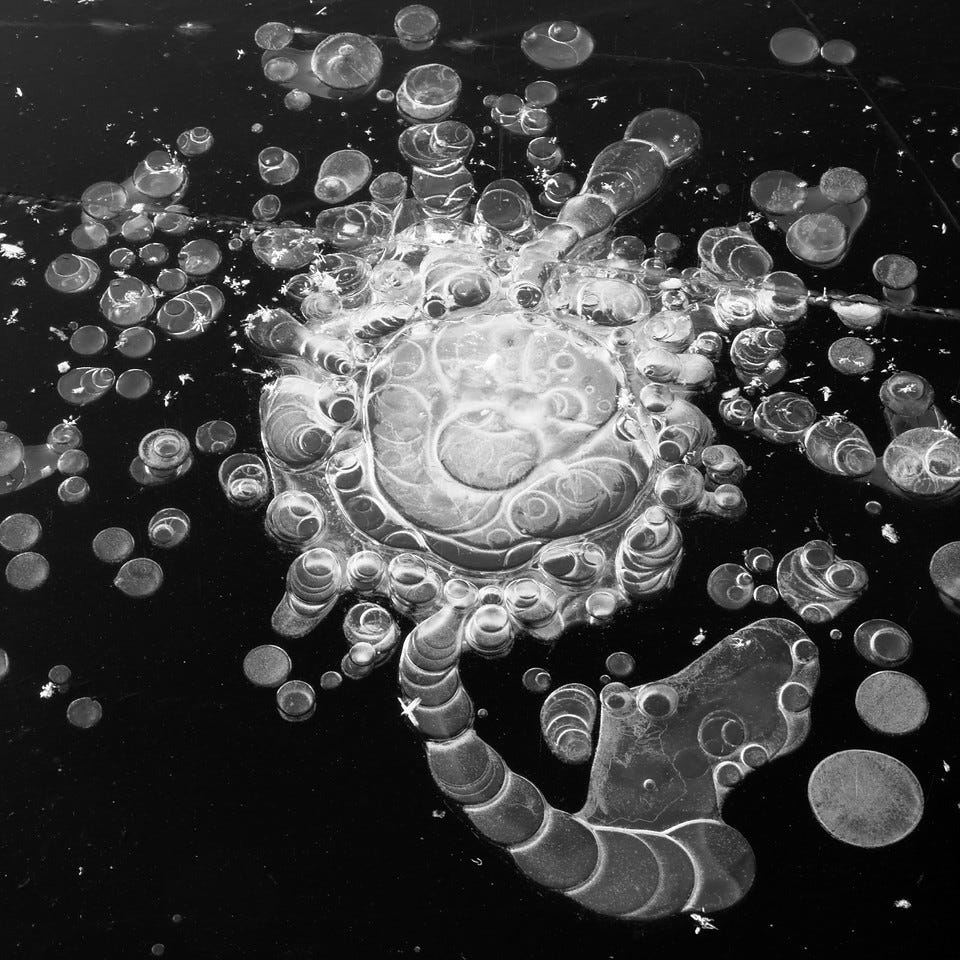
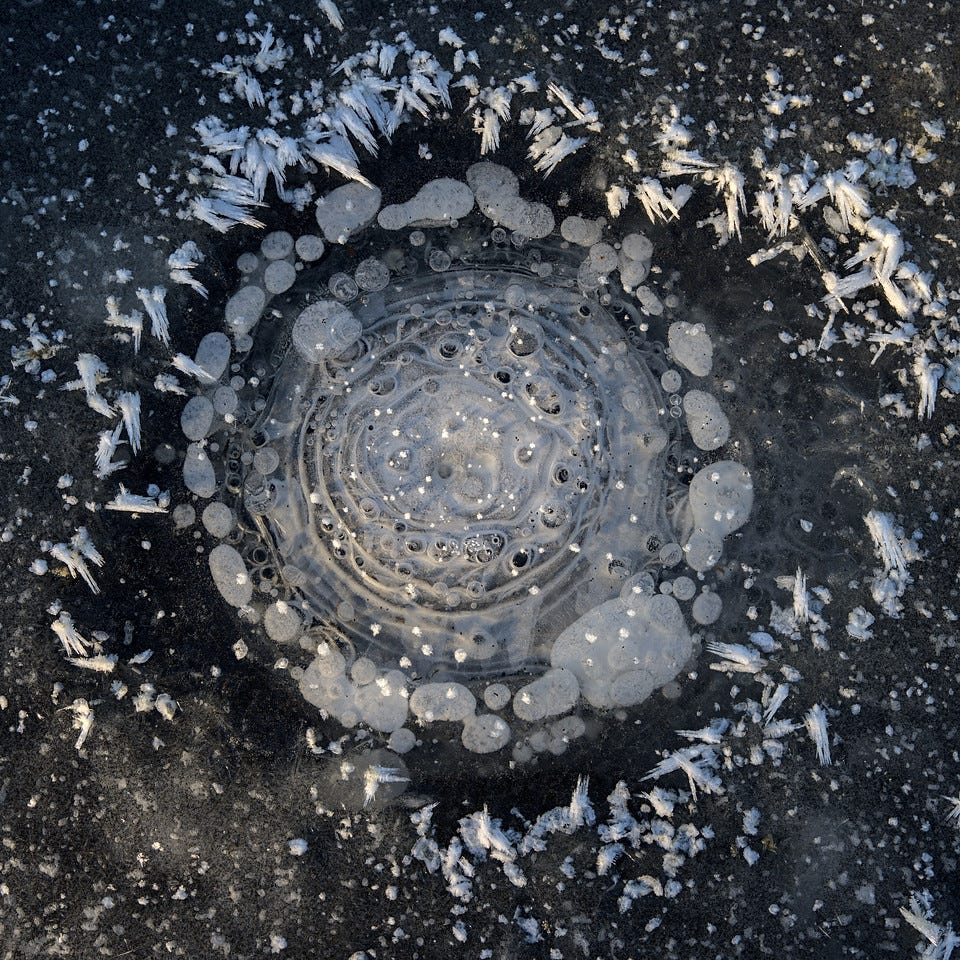
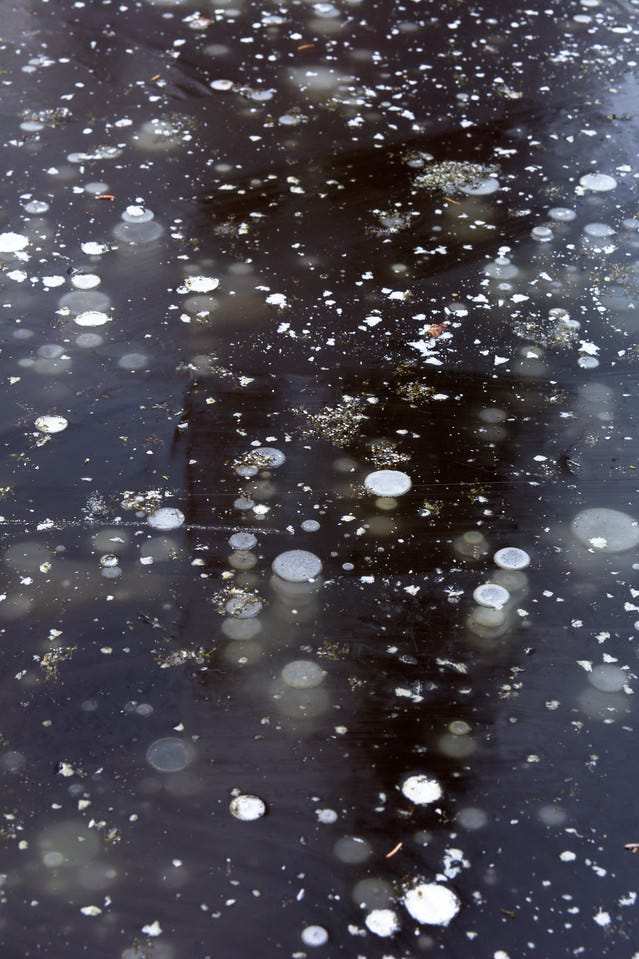
In the case of my lake star on Ballaine, it appears the hole stayed open and seeping because methane escaped from the lakebed, bringing warmer water from the bed toward the freezing surface. These methane leaks in interior Alaska often result from thawing permafrost, as microbes break down organic matter in the thawed ground beneath the lake.
As the lake freezes, the slowly escaping gas can create stunning patterns in the ice, as shown in the photos below from Smith Lake in Fairbanks.
Europa’s Manannán Crater Spider Feature
Scientists are using ice-star formation mechanisms to explain how a ‘striking’ (pun intended) feature formed in an impact on Jupiter’s moon Europa.
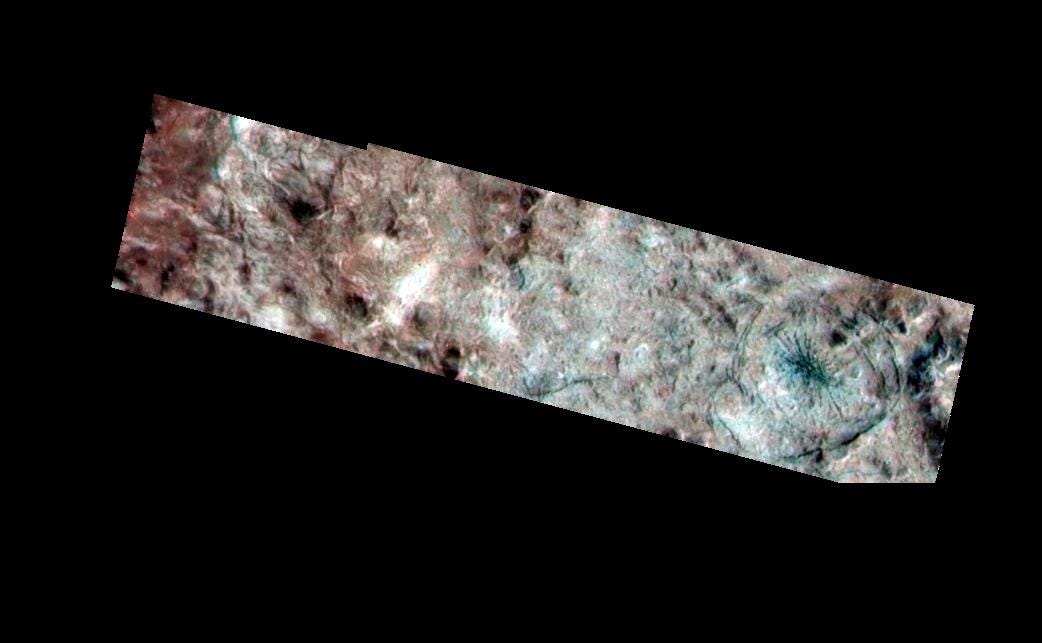
The feature at the crater's center has been informally named Damhán Alla, Irish for “spider.” The crater is 22 km in diameter, and the asterisk-shaped feature at the center shows no perceptible relief that would be expected if these were fractures.
The hypothesis states that the impact that formed the crater partially melted the ice and created a brine reservoir beneath the surface. As the brine froze, the less dense solid expanded, increasing internal pressure. This caused a crack to form, and the liquid erupted onto the surface, spreading through the porous ice layer in the same manner as a lake star.
NASA’s Europa Clipper mission, launched on October 14, 2024, will conduct nearly 50 flybys of Europa, beginning in 2031, to make detailed surface measurements. If this mission reveals more detail about the surface topography and morphology, it could provide more evidence for the lake star hypothesis and help infer subsurface conditions.
References
Mc Keown, L.E., et al. (2025). Lake Stars as an Earth Analog for Europa’s Manannán Crater Spider Feature. The Planetary Science Journal, 6, 279. https://doi.org/10.3847/PSJ/ae18a0
NASA Europa Clipper Team. (2019, January 8). Mannann’an Crater. NASA Science. https://science.nasa.gov/missions/europa-clipper/europa-clipper-resources/mannannan-crater/ (Image: NASA/JPL/University of Arizona)
Thoreau, H.D. (1954). Walden; or, Life in the Woods. Boston: Ticknor and Fields.
Tsai, V.C., & Wettlaufer, J.S. (2007). Star patterns on lake ice. Physical Review E, 75, 066105. https://doi.org/10.1103/PhysRevE.75.066105 (preprint:arXiv:0704.1504)